
Gallery Hours:
Mon - Wed 12pm - 5pm
Thu - Fri 12pm - 7pm
Opening Reception Thursday, May 28th 5pm - 8pm
Curatorial/Artist Talk & Tour Thursday, June 4th 5:30pm - 7pm
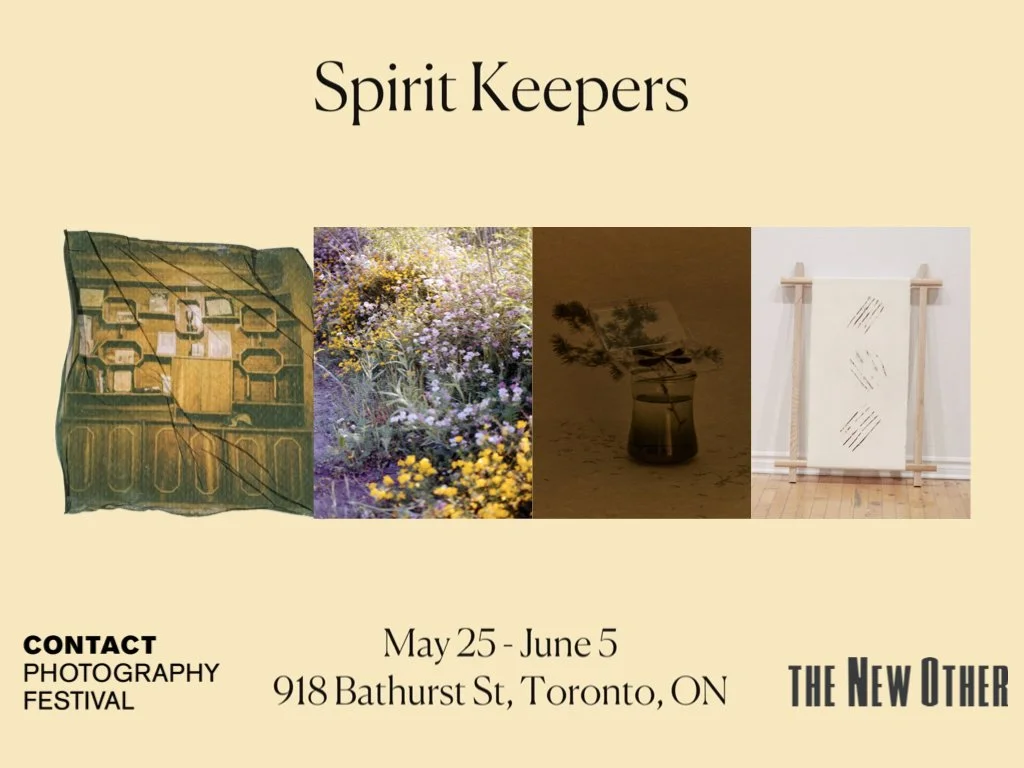
Co-curated with Steffi Sin Tung Ng, the group exhibition Spirit Keepers—featuring Tkaronto/Toronto-based artists Alex Hall, Kristi Chen, Marzieh Miri, and Yujie Wang—explores the potential of image making to capture and reimagine fragmented memories, lost ancestral ties, and the histories that abide as “spirits” within Asian diasporic experiences and identities.
Since its invention, the camera has been explored as a tool for capturing the invisible. Aside from its spectral qualities, the medium fixes the ephemeral—a crack in a childhood home, the lace-like pattern of a dragonfly’s wing, the pulse of ripples in a lake. As philosopher Walter Benjamin observed, “A touch of the finger now sufficed to fix an event for an unlimited period of time. The camera gave the moment a posthumous shock, as it were.”1 Through its lens, fleeting moments are kept as enduring traces. Images become the vessels where the spirits of the subjects remain.
This preoccupation with invisible yet lasting traces is echoed in the etymology of the Chinese name for photography. While the Western understanding of photography comes from the ancient Greek roots of phōs and graphé, meaning “to write or draw with light,” the Chinese term “攝影” (Cantonese pronunciation: sip jing) can translate literally to “capture the shadow.” This liminal space between light and shadow, the fleeting and the enduring, serves as an entry point to this exhibition.
Drawing from their Asian diasporic experiences, the four featured Tkaronto/Toronto-based artists—Alex Hall, Kristi Chen, Marzieh Miri, and Yujie Wang—approach this liminal space through their diverse practices of image making. Here, image making is not only confined to lens-based media, but also expands into the tactile and the sculptural.
Hall explores her family’s immigration histories and stories from a mixed-heritage perspective through Chinatowns in Barkerville (British Columbia), Toronto (Ontario), and the surroundings of her nearby hometown in Oakville; Chen weaves together narratives of cultural adaptation and intergenerational knowledge through the ritual of burning incense; Miri recollects the fluid, ever-changing memories of her home in Iran; and Wang orients our gaze to the absence, the sublime found within nature and the everyday.
Their artworks open up spaces of inquiry and exploration. What and where are the spirits within Asian diasporic identities? How can images serve as a medium to express, preserve, and reimagine the in-betweenness of diasporic experiences?
Taking place during Asian Heritage Month, and set in the former location of the Japanese Buddhist Church of Toronto, the artists and their works act as spirit keepers. Instead of offering foregone answers, they invite the audience to join them in this role—bringing their narratives into view by dwelling within the light and shadow, the transience and permanence, the presence and absence that lingers within our histories, identities, and memories.
Walter Benjamin, “On Some Motifs in Baudelaire,” in Illuminations, ed. Hannah Arendt, trans. Harry Zohn (New York: Schocken Books, 1968), 174–75.